
Role
Product Designer reporting to stakeholders: UX Strategist, Head of Product, and a team of Community Engagment Coordinators.
Timeline
Aug - Oct 2024
3 months
Project Type
Integrating a new feature into Narraive Native's existing native app.
Skills
User Interviewing
Content Strategy
UI Design
Prototyping
Background
Real Reviews, Redefining Care.
The Irth App fills a crucial gap in maternal healthcare by offering reviews for Black and Brown birthing parents, covering prenatal, birthing, postpartum, and pediatric care. It empowers users to find culturally relevant and accurate information about care providers and facilities, amplifying the voices of not only moms, but partners, doulas, and midwives.
Problem
Black and Brown birthing parents often face healthcare disparities, with both unique and universal needs overlooked. Irth App’s previous search function lacked critical provider information, limiting their ability to make informed, confident choices before and during pregnancy. Leadership was unsure where to improve.

Solution
This new Irth App feature addresses this gap by offering culturally competent reviews and a deeper, more relevant search function to connect moms with trusted care providers, empowering informed, confident decisons throughout their journey.
Impact
A successful execution that brought business goals and concepts to reality, bridging complex challenges and overcoming roadblocks. Despite limited resources, this solution sparked new directions, clarified design challenges, and provided a tool for visualizing growth potential.
Background
Overview
Reclaiming Trust in Maternal Care.
Access to culturally competent healthcare remains uneven, leaving Black and Brown birthing parents without the critical insights needed to make informed decisions. Irth App’s previous search function lacked essential provider details, limiting users’ ability to find the right care. Without clear guidance, leadership struggled to pinpoint necessary improvements.
Through strategic UX research and iterative design, we reimagined the search experience to enhance provider transparency, refining review structures, and ensuring users could seamlessly connect with trusted, relevant care. The result was a platform that not only amplifies community voices but also empowers parents to advocate for themselves at every stage of their journey.
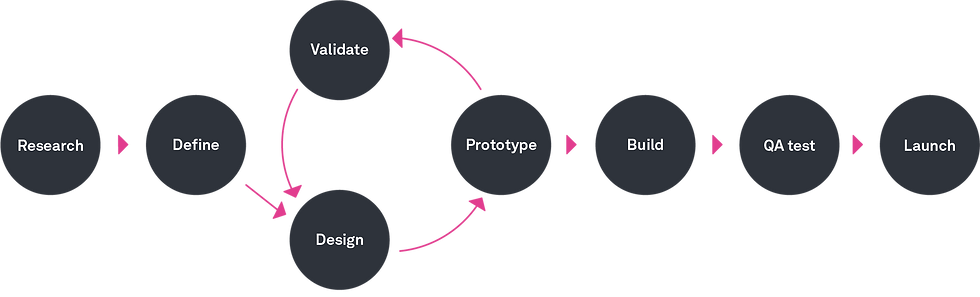
Design Process
I took the lead on executing a user-evidenced feature, which allowed me to present findings to stakeholders and shine a light on the roadblocks users were facing. As the UX Designer, I focused on research, validation, and refining critical flows through iteration. While there were time constraints, I worked to incorporate key UI improvements and noted additional suggestions for future enhancements.
Throughout the process, I kept user needs at the heart of every decision, ensuring their voices were heard while setting aside personal biases. In the end, I delivered a final prototype that addressed major user pain points and successfully aligned with stakeholder current and future goals, even though time and resources were limited for extensive testing.
Research
Understanding the Challenges of Irth App Users
4 out of 5
Eighty percent of participants prioritized insights from trusted family and friends over online reviews, often perceiving the latter as vague and biased.
4 out of 5
Eighty percent of participants emphasized the need for care that embodies empathy and equity, highlighting the importance of quality relationships in their healthcare experiences.
3 out of 5
Sixty percent of participants found existing information about labor and delivery facilities or providers to be unclear or difficult to access.
Our user research began with in-depth interviews with five participants combined with regular stakeholder meetings to provide updates on research outcomes. These insights from affinity mapping informed a user journey map which helped me to remove obstacles in solving for this problem and gain direct feedback on the direction of the project.






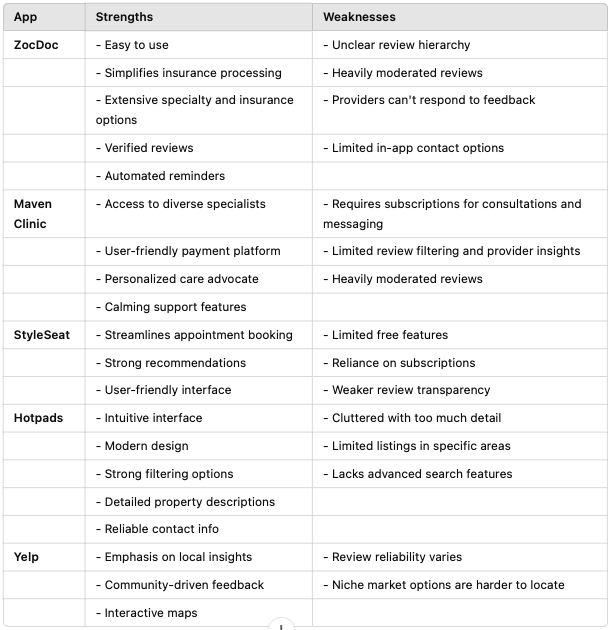
Competitive Analysis: Digital Tools for Search Assistance
Creating a competitive analysis chart provided deeper insight into the digital landscape for current and aspiring moms and their families. Combined with user interviews, this approach revealed opportunities within the market to present information in a more simple, desirable, and digestible way.

User interview insights were used to inform the persona so the added feature addressed real habits and challenges faced, rather than fictional assumptions.
Cumulative Insights on User Values and Tactics
Creating a user persona for this UX/UI design process was done through affinity mapping. This allowed me to establish clear business and user goals:
-
The added feature is needed to illuminate the credibility and trustworthiness of the Irth App as a reliable care evaluation source.
-
Help moms (defined by findings and insights) make a streamlined, fast, and assured, decision to hire or not to hire.
-
Constraint and consideration to factor in: Stakeholder requested user anonymity unless personally disclosed, how might we accomplish this and honor the business and user goal?

I synthesized user interview findings through affinity mapping, organizing key insights to uncover patterns in the maternal health journey. Using the same sticky notes (with a few additional added for new focal points), I mapped out the most relevant stages for this project, transforming user challenges and business goals into actionable feedback. This process aligned feedback conversations, clarified focus, and helped overcome early conceptualization hurdles. Additionally, the map provided a clear, chronological view of the maternal care experience, highlighting opportunities for improvement and guiding stakeholders toward informed decisions.
Define


Home Page Content Exploration
Defining features was challenging, as it required reorganizing the existing homepage content. To tackle this, I conducted multiple rounds of hand sketches and low-fidelity wireframing, incorporating feedback at each stage to refine the design.
Testing Medium Fidelity Wireframes
Content Planning with Evidence-Based Features

Search Result Sketching
Similarly, the search results were predefined, making it crucial to assess which elements could remain and which needed evidence-based improvements or redesigns to enhance usability.

Explore Page
Redesigned the layout and content structure to surface the most relevant providers, streamline navigation, and create a more intuitive, trust-building exploration experience.

Search Result Sketching Pt. 2
Further exploring ways to enhance filtering, provider details, and community-driven insights while maintaining clarity and ease of use.
Insights from Medium Fidelity Testing
I conducted usability testing for Irth, bridging a critical gap between features and audience that had previously been unaddressed due to limited resources. By refining user flows, improving task completion, and eliminating friction points, I played a key role in enhancing the app’s usability.
A key challenge was low user participation due to the sensitive nature of maternal healthcare and time constraints. To address this, I sourced engagement coordinators - doulas and mothers familiar with the app’s strengths and weaknesses - as well as target users considering doula care. Reporting to a UX Strategist and Head of Product, I collaborated with coordinators to refine interaction patterns and enhance the UX from medium to high fidelity. Additionally, I strategically selected participants based on user personas and key qualifications to ensured actionable feedback that directly informed design improvements.

Wireframes illustrating the core tasks: account creation, challenge viewing, course enrollment, and community posting.
Usability testing uncovered key issues:
-
Inconsistent provider role/titles across screens.
-
Low search bar font contrast impacts readability.
-
Confusing review breakdowns and unclear rating logic.
-
Navigation difficulties, especially in backtracking.
-
Vague button labels causing hesitation (e.g., "Next, Message Tina").
-
Missing interactive elements like hospital filtering.
-
Branding inconsistencies in spacing, font hierarchy, and UI elements.
At this stage, while there were many opportunities to enhance Irth App’s user experience, prioritization was essential. I navigated key pivot points and decision-making to ensure meaningful improvements within the given time constraints.
To optimize usability within the timeline, I:
-
Reduced provider evaluation criteria from six to three to minimize cognitive load.
-
Removed video intros and profile sharing due to low impact versus effort.
-
Apart from UI, I chose to focus on adjusting the current platform's navigation inconsistencies to improve task confidence within this project's scope.
-
Prioritized key button and label adjustments while planning future refinements.
-
Moderated Testing via Zoom (40–50 minutes)
-
Data was synthesized from transcribed audio recordings, analyzing patterns in findings.
-
Scope: Three days of scheduled calls, spaced out to maintain progress on the timeline.
-
Participants: Six individuals, including parents and non-parents - one expecting mother and others with previous birthing experience.
-
Stakeholder Engagement: Weekly feedback meetings on design direction and regular Slack check-ins for updates and insights.
-
Objective
Evaluate the ease of finding, messaging, and scheduling a doula through the Irth App while assessing clarity, trustworthiness, and overall user experience.
Task 1: Finding a Doula
Scenario: You are looking for a doula who meets specific criteria.
Instructions:-
Open the Irth App.
-
Navigate to the section where you can search for a doula.
-
Find a doula who:
-
Is affiliated with Harlem Hospital Center
-
Has a 5-star rating
-
Is also a Certified Nurse Midwife (CNM)
-
Follow-up Questions:
-
How did you find the process of locating a doula that meets your criteria?
-
(Explain out loud, then rate 1-5 stars)
-
-
Were the filters and search options intuitive? Why or why not?
Task 2: Messaging a Doula
Scenario: You’ve found a doula and want to ask her a question before making a decision.
Instructions:-
View the doula’s profile from your search results.
-
Use the app to send the following message:
-
“What is your experience with home births?”
-
-
Show how you would do this.
Follow-up Questions:
-
How straightforward was it to send your question?
-
(Explain out loud, then rate 1-5 stars)
-
-
Was the messaging process clear and efficient? Why or why not?
Task 3: Scheduling a Doula
Scenario: You decide to move forward and schedule a consultation with the doula.
Instructions:-
Navigate to the scheduling feature after messaging the doula.
-
Attempt to book a consultation.
Follow-up Questions:
-
How did you find navigating to the scheduling feature after messaging?
-
(Explain out loud, then rate 1-5 stars)
-
-
Did the scheduling process feel intuitive? Why or why not?
Final Impressions & Trustworthiness-
How did you feel about your decision to work with the doula based on the available information?
-
(Explain out loud, then rate 1-5 stars)
-
-
Were the reviews and provider details clear and trustworthy?
-
Why or why not? How would you improve them?
-
Additional Feedback-
What, if anything, frustrated you during this process?
-
What features or improvements would make the experience better?
End of Usability Test
Thank you for your time and feedback!-
Prioritizing and Refining Usability
To prioritize and refine usability issues, I used:
-
Mentor Feedback & Critiques: Insights guided key refinements before high fidelity.
-
Usability Test Playbacks: Identified friction patterns across 4/5 recorded sessions.
-
Rainbow Spreadsheet Methodology: Tracked and categorized feedback for prioritization.
-
Cross-functional Collaboration: Validated refinements with engagement coordinators.
Testing High Fidelity Wireframes
Onboarding and Content Calibration
Insights from Irth's Audience
Information Clarity
Inconsistent provider titles and rating breakdowns (languge murkiness) caused users to lag in time spent decision making.
Visual Hierachy & Readability
Low-contrast search bar text reduced readability, while inconsistencies in spacing, font hierarchy, and UI elements disrupted visual flow.
Navigation & Interaction
Unclear navigation paths made backtracking difficult, and vague button labels caused hesitation in completing actions.
Feature Gaps
The absence of hospital filtering and other key interactive elements limited users' ability to refine their search effectively.
I conducted six usability tests. Initial sessions showed participant confusion, leading me to investigate friction sources. To ensure this second round of testing clarified core usability concerns I used approaches such as:
-
Follow-Up Questioning: Identified friction points to uncover root causes of confusion and refine the prototype.
-
Maze to High-Fidelity Transition: Shifted from attempting to use Maze to direct prototype narration for clearer insights.
-
Prioritization Strategy: Focused on P1-P2 issues while noting P3s for future iterations.
%20Testing%20Screens.jpg)

High Fidelity wireframes (L) illustrating the wireflow and prototype I used to create a rainbow spreadsheet (R). This synthesized data informed evidence-based and priority design iterations.
Develop
Inconsistencies in the current design system were a challenge in adding this feature. To solve this, I studied the current app, comparing it to their documented UI Kit to shave away gaps and create unity and visual balance. A comprehensive UI kit was developed to ensure visual consistency and scalability. It included typography, color palettes, iconography, and component libraries, serving as a valuable resource for the development team and future updates.
Style Guide Improvements
![[Master] Components.jpg](https://static.wixstatic.com/media/a6d5b0_fcba4ba0a73b40ed9050373091b8ff14~mv2.jpg/v1/crop/x_5447,y_6787,w_8549,h_11148/fill/w_980,h_1278,al_c,q_85,usm_0.66_1.00_0.01,enc_avif,quality_auto/%5BMaster%5D%20Components.jpg)
Icons, Buttons, Components
(Click the mage for a closer look)
To stay aligned with the design system and project timeline, I mapped relevant components and tracked necessary additions.
![[Master] Typography.jpg](https://static.wixstatic.com/media/a6d5b0_f8c28c18accd40e395280a2033f5d655~mv2.jpg/v1/crop/x_525,y_444,w_3570,h_4655/fill/w_507,h_661,al_c,q_80,usm_0.66_1.00_0.01,enc_auto/%5BMaster%5D%20Typography.jpg)
Typeset Simplification
I conducted a heuristic UX audit to identify inconsistencies in the previous typeset (app fonts are marked in green).
![[Master] Color Scheme.jpg](https://static.wixstatic.com/media/a6d5b0_54f0d80e4049453d9465266bf0c4acb1~mv2.jpg/v1/crop/x_202,y_408,w_5517,h_7195/fill/w_980,h_1278,al_c,q_85,usm_0.66_1.00_0.01,enc_avif,quality_auto/%5BMaster%5D%20Color%20Scheme.jpg)
Color Scheme
I developed a cohesive color scheme by identifying all active, inactive, and one-off colors in their screens using Figma. This enhancement improved visual clarity, a change users recognized during testing.
Final Iterations of High Fidelity Screens
Implementing Change into the Final User Experience
Deliver
Iterative Outcomes: Feature enhancements
Layout and Visibility
Profile headers and whitespace were refined, while the message button was repositioned for better
accessibility.
Stronger information hierarchy and improved task efficiency.
Content and Readability
The "About Me" section was expanded for clarity without adding clutter.
Enhanced readability through better contrast and spacing.
Consistency and Standardization
Button and label designs were unified to create a more cohesive user experience.
Reduced user friction via streamlined interaction touchpoints.
Refined UI Foundations
Early iterations focused on improving search bar contrast, aligning UI elements, and standardizing micro star ratings for consistency.
A roadmap for resolving branding inconsistencies in future iterations.


Consultation Scheduling to Establish Next Steps
This visual asset helps the user to solidify the next step forward in their family's maternal care journey.
Provider Messaging Pathway for Connection Building
Painting the full picture of who mom is seeking to collaorate with.
Chat System Access to Grow User Confidence
This improvement bridges the gap between the user and care provider as they establish a relationship.
My final exploration of focused setting questions (L), notification of successfully generated content, home page content planning, and content with audio and print flexibility led to more focused UI exploration and a pivot to onboarding depth.
Client Testimonial
Outcome of Partnership

Co-Founder of Actor's Pocket Guide: Anatole N.
"
Next Steps and Future Considerations
Due to resource limitations, the Irth App was unable to move into full development at this time. However, if given more time and resources, I would focus on three critical areas to strengthen usability, engagement, and trust:
-
UI Consistency & Accessibility: A deeper audit of the app’s interface revealed inconsistencies in button sizing, iconography, font hierarchy, and spacing. Additionally, adjusting the primary color for better accessibility would enhance readability. These refinements would create a more polished experience that aligns with user expectations with trustworthy platforms.
-
Brand & Language Standardization: Inconsistencies in terminology across different screens created unnecessary friction. Establishing a clear, uniform language system throughout the app would build familiarity and trust, ensuring users feel more confident in their interactions.
-
Deeper User Research & Personalization: While the testing phase validated the need for key information on provider profiles, there’s an opportunity to refine search filters and profile content to better serve the diverse needs of moms and families. A more tailored approach could improve user engagement and further simplify decision-making.
Through strategic usability refinements - reducing cognitive load, streamlining navigation, and clarifying interaction points - I laid the foundation for a more intuitive and effective experience. While this phase of development concluded, the insights gained provide a strong roadmap for future iterations, ensuring Irth is positioned for long-term success.
Experience Irth App's Message Prototype
The final prototype showcases a solution by way of a robust, evidence-based search function to find and contact a care provider, enhancing support and confidence in maternal health decisions. By addressing key user pain points, it set a new standard for platforms in this space. Users highlighted the simplicity and clarity of the interface, emphasizing how it brought simplicity to a complex space.

From Insight to Action: Creating the Personalized Feature
Task flows revealed where user would encounter potential roadblocks, such as redundant steps or unclear navigation paths. But, a simple task flow identified critical tasks such as "searching for resources" and "tracking progress" that needed simplification. For instance, our user flow illustrated a direct route from logging in to accessing tailored recommendations, bypassing unnecessary steps. Affinity mapping further helped organize user insights into actionable design priorities, aligning them with the platform’s core objectives.
